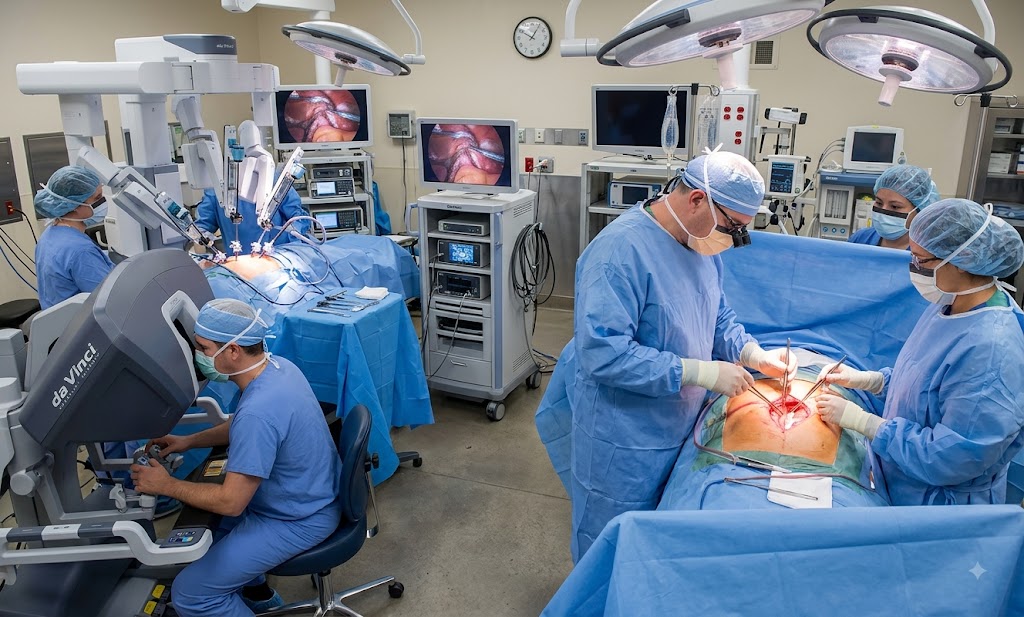
Robotic vs. Open Surgery for Throat and Voice Box Cancer: What Actually Differs for the Patient
Somewhere in the consultation,
the word "robotic" comes up, and it tends to land one of two ways.
Either it sounds reassuringly high-tech, or it sounds like a sales pitch for
something more expensive than it needs to be. Neither reaction is particularly
useful when you're the one trying to decide between two real surgical
approaches for a cancer in your throat or voice box.
The honest answer is that
robotic and open surgery aren't simply a "better" and
"worse" version of the same operation. They access the tumour
differently, and that difference in access is what tends to matter most to the
patient afterward — not during the surgery itself, but in the weeks and months
of recovery that follow.
The core difference: how the surgeon reaches the tumour
Open surgery for cancers of the
oropharynx, larynx, or hypopharynx has traditionally required an external
incision, and in some cases splitting the jawbone (a mandibulotomy) to get
adequate visibility and access to the tumour. It's a well-established approach
with decades of outcome data behind it, and for many tumours — particularly
larger or more anatomically complex ones — it remains the right choice.
Transoral robotic surgery (TORS)
reaches the same region through the mouth, using a robotic system that gives
the surgeon a magnified, three-dimensional view and instruments that can
articulate in ways human hands cannot inside such a confined space. No external
incision, no jaw-splitting, in most eligible cases. That access difference is
the whole story behind most of what changes for the patient afterward.
What the research shows about recovery and function
This has been studied fairly
extensively for oropharyngeal cancer, and the pattern across multiple
systematic reviews is consistent. A 2020 systematic review comparing TORS with
open surgery across sixteen outcome measures found that TORS was associated with
better overall functional outcomes and fewer intraoperative and postoperative
complications, with no meaningful difference in positive margin rates or
survival between the two approaches.
Swallowing function in
particular shows up repeatedly as an area where TORS tends to perform better.
Open surgery involving mandibulotomy has historically carried a real risk of
longer-term difficulty with speech and swallowing, related to the disruption
involved in accessing the tumour through the jaw. Robotic approaches, by
avoiding that step, are associated in the literature with shorter hospital
stays and comparatively better swallowing outcomes in the recovery period.
A separate comparative study
specific to hypopharyngeal cancer — a less common but harder-to-reach site —
found comparable oncologic outcomes between TORS and radical open surgery, with
the TORS group showing better results on standardised quality-of-life measures
covering pain, swallowing, speech, and overall recovery. For laryngeal cancer
specifically, robotic approaches to the supraglottic larynx have similarly been
linked to fewer post-operative complications and improved functional recovery
compared with open techniques, in patients selected as suitable candidates.
Where robotic surgery is not automatically the better choice
None of this makes TORS a
universal upgrade. Eligibility depends heavily on tumour size, stage, and —
critically — whether the tumour can actually be reached and adequately
visualised through the mouth. Larger, more advanced, or awkwardly positioned
tumours may simply not be accessible this way, regardless of how experienced
the surgical team is. In those situations, open surgery isn't a fallback
option; it's the medically appropriate one.
Cost is also a genuine factor,
and not just for the patient. One review comparing TORS with open surgery and
with transoral laser microsurgery noted that the high upfront investment
required for robotic systems affects its cost-effectiveness relative to other
approaches, even where functional outcomes favour TORS. This is worth knowing
simply so the decision doesn't get reduced to "newer must be better"
— the right approach is the one that matches your specific tumour, not a
general preference for either method.
Questions worth asking before deciding
- Is my tumour's size, stage, and location actually
suitable for a transoral robotic approach?
- If I'm a candidate for both, what specific difference
in recovery time and swallowing function would I realistically expect?
- Would open surgery in my case require a mandibulotomy,
and if so, what does that mean for recovery?
- How many robotic procedures has this surgical team
performed for this specific tumour site?
- If robotic surgery isn't suitable for me, why not — understanding the reasoning matters more than the label on the technique.
Frequently Asked Questions
1. Is
robotic surgery always better than open surgery for throat cancer?
No. It tends
to show better functional and recovery outcomes in patients who are good
candidates for it, but eligibility depends on tumour size, stage, and location.
For tumours that aren't accessible transorally, open surgery remains the
appropriate choice.
2. Does
robotic surgery have worse survival outcomes than open surgery?
Published comparisons have generally found no
significant difference in survival or clean-margin rates between the two
approaches when patients are appropriately selected for each.
3. Why
does swallowing recover better after robotic surgery in some studies?
Much of this is linked to avoiding mandibulotomy and
reducing disruption to surrounding healthy tissue, rather than the robotic
technology itself — the access route is the main variable.
4. How
do I know if I'm a candidate for robotic surgery?
This depends on your tumour's exact site, size, and
stage, assessed through examination and imaging. A specialist experienced in
both approaches can advise which is appropriate for your specific case.
5. Is robotic surgery more expensive than open surgery?
It can be, partly reflecting the cost of the robotic system itself. Whether that's a relevant factor depends on your treatment plan and should be discussed directly during consultation.
Making the decision
If you've been offered either
option, the more useful question isn't "which technique sounds more
advanced" but "which one fits my specific tumour, and what would
recovery actually look like for me." That's a conversation worth having
directly with a surgeon experienced in both approaches, ideally with your
imaging and biopsy findings in front of you, so the recommendation is based on
your case rather than a general preference for one technique.