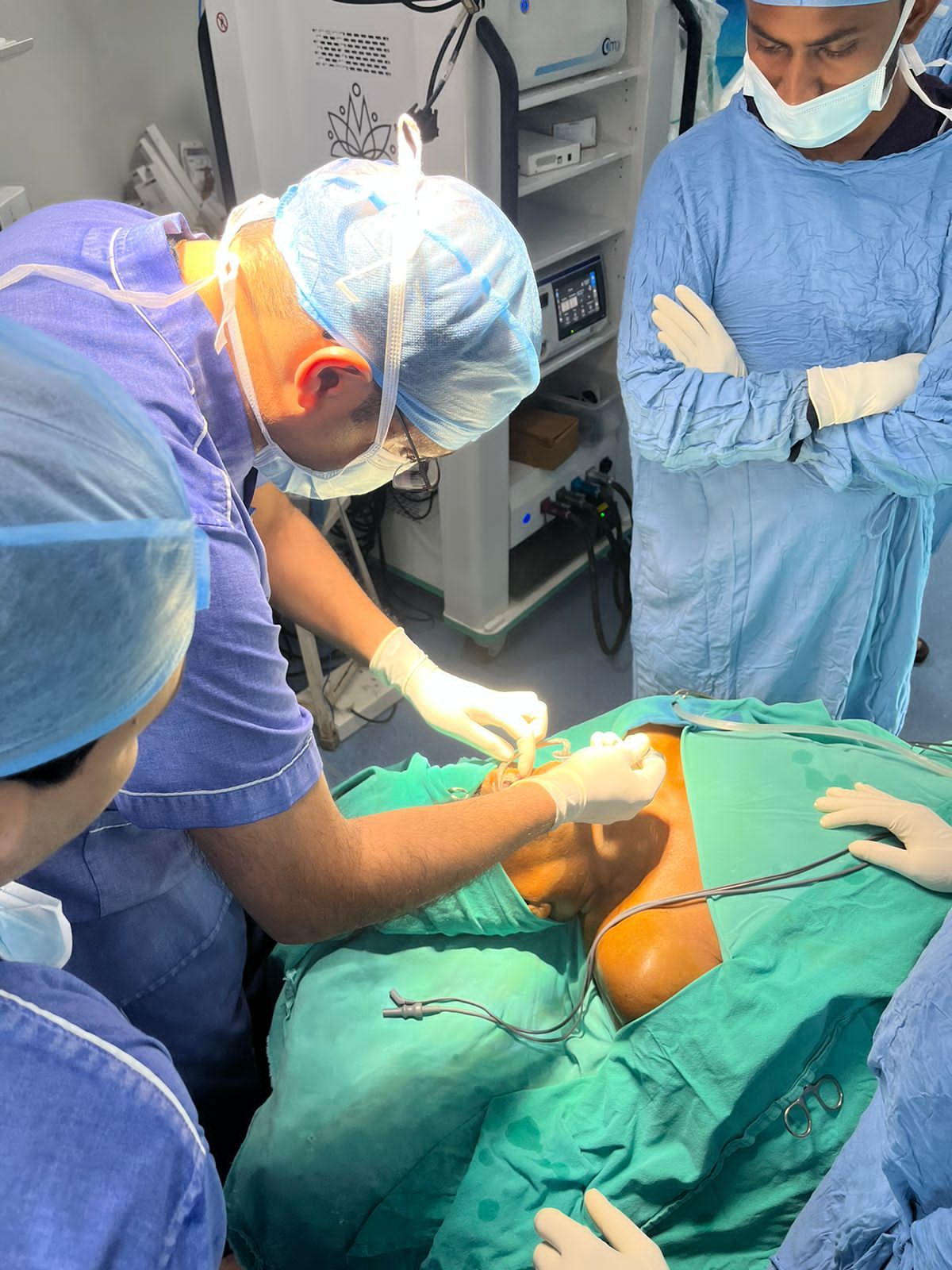
Specialized surgical care for Oral, Tongue, Thyroid, Throat, Voice Box, Salivary Gland, and Head & Neck Cancers with advanced treatment and personalized care.
Please fill out the form below to book your consultation layer.
Oral cavity cancer, commonly called mouth cancer, can affect the tongue, cheeks, gums, floor of the mouth, palate, or lips, and surgery is the primary treatment for most patients. Dr. Karan Gupta, a fellowship-trained Head & Neck Oncosurgeon, plans and performs oral cavity cancer surgery in Delhi NCR, from smaller excisions for early disease to more extensive procedures such as composite resection and neck dissection when the cancer is more advanced, with reconstruction planned to preserve speech, swallowing, and appearance wherever possible.
Oral cavity cancer, also known as mouth cancer, develops in the parts of the mouth involved in chewing, swallowing, and speaking. It can arise in the front two-thirds of the tongue, inner cheeks (buccal mucosa), gums, floor of the mouth, hard palate, retromolar trigone behind the wisdom teeth, or the lips. Squamous cell carcinoma is the most common type of oral cavity cancer. In India, the leading risk factors include smoking, smokeless tobacco products such as gutka, khaini, and tobacco-containing paan, areca (betel) nut chewing, and regular alcohol consumption, especially when combined with tobacco use. Oral cavity cancer is one of the most common forms of head and neck cancer, and treatment often involves tumour removal, neck management, and reconstructive surgery to restore function and appearance.
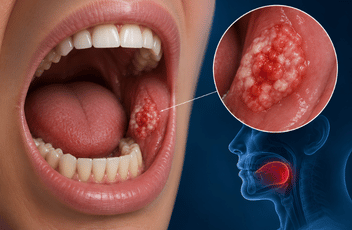
Persistent changes inside the mouth that last beyond two to three weeks should be evaluated by a Head & Neck Cancer Specialist rather than assumed to be a minor ulcer or dental problem. Early diagnosis significantly improves treatment outcomes.
A mouth ulcer or sore that has not healed within two to three weeks should always be examined by a specialist.
A persistent red or white patch inside the mouth that does not disappear requires prompt medical evaluation.
Ongoing pain in the tongue, inner cheek, or gums should not be ignored, especially if it continues for several weeks.
A lump, swelling, or thickened area inside the mouth or cheek should be assessed without delay.
Teeth becoming loose without an obvious dental reason may indicate involvement of the jaw or surrounding tissues.
Difficulty opening the mouth fully (trismus) can be an important warning sign of oral cavity cancer.
Bleeding from the mouth without injury or an obvious dental cause should be investigated promptly.
A painless or persistent lump in the neck may indicate spread to the lymph nodes and requires urgent evaluation.
Oral cavity cancer treatment begins with an accurate diagnosis and staging to determine the size, depth, and spread of the tumour. Based on these findings, Dr. Karan Gupta develops a personalized surgical plan to achieve complete cancer removal while preserving speech, swallowing, and appearance whenever possible.
Diagnosis begins with a detailed clinical examination and biopsy of the suspicious lesion. MRI or CT scans help determine the extent of the tumour, while PET-CT may be recommended for advanced disease. Staging considers not only the size of the tumour but also its depth of invasion, which influences the risk of spread to the neck lymph nodes and helps guide treatment planning.
Recommended for smaller, early-stage oral cavity cancers. The tumour is removed along with a margin of healthy surrounding tissue to reduce the risk of recurrence while preserving as much normal tissue as possible.
For tongue cancers, surgery may involve removing part of the tongue (partial glossectomy) or, in more extensive cases, a larger portion of the tongue depending on the tumour's size, location, and depth.
Performed when the cancer involves or lies close to the jawbone. This procedure removes the tumour, the affected portion of the jawbone, and the involved neck lymph nodes in one operation, followed by reconstructive surgery when required.
Neck dissection is performed when cancer has spread to, or carries a significant risk of spreading to, the neck lymph nodes. It is commonly carried out during the same operation as removal of the primary tumour.
Larger surgical defects are reconstructed using local, regional, or microvascular free flaps. Reconstruction is planned during the same surgery to restore speech, swallowing, facial appearance, and overall quality of life as effectively as possible.
Careful preoperative planning helps determine the exact extent of your oral cavity cancer and ensures that surgery, reconstruction, and recovery are planned in the safest and most effective way.
Recovery after oral cavity cancer surgery depends on the extent of the procedure performed. Patients undergoing a smaller excision may return home sooner, while those requiring composite resection and reconstructive surgery generally need a longer hospital stay, closer monitoring, and a structured rehabilitation plan.
Dr. Karan Gupta provides comprehensive surgical care for oral cavity (mouth) cancer, combining advanced head & neck oncology training with personalized treatment planning to achieve complete cancer removal while preserving speech, swallowing, and appearance whenever possible.
Fellowship-trained in Head & Neck Surgical Oncology at Tata Memorial Hospital, Mumbai, and HCG Cancer Centre, Ahmedabad.
Further trained in Robotic Head & Neck Surgery through the Vattikuti Foundation, Michigan, USA, with expertise in advanced minimally invasive surgical techniques.
Intuitive Surgical USA Certified Robotic Head & Neck Surgeon with internationally recognized robotic surgery certification.
Honoured with Triple Gold Medals across MBBS, MS, and DNB for outstanding academic and surgical excellence.
Every oral cavity cancer surgery is individually planned based on the tumour's site, size, depth, and stage. Treatment may range from wide local excision to glossectomy, composite resection, neck dissection, and reconstructive surgery, ensuring a comprehensive, patient-specific treatment strategy rather than a one-size-fits-all approach.
Find answers to common questions about oral cavity (mouth) cancer, oral cancer surgery, neck dissection, reconstruction, recovery, and treatment by Dr. Karan Gupta.