• -----------
  • +91 9811122341
Chat on WhatsApp
Expert Cancer Care

Advanced Oral Cancer Surgery in Delhi NCR

Specialized surgical care for Oral, Tongue, Thyroid, Throat, Voice Box, Salivary Gland, and Head & Neck Cancers with advanced treatment and personalized care.

Request an Appointment

Please fill out the form below to book your consultation layer.

Composite Resection Surgery in Delhi NCR for Advanced Oral Cancer

When oral cancer involves or lies close to the jawbone and has a meaningful risk of spreading to the neck lymph nodes, composite resection is the preferred surgical procedure to remove all affected tissues in a single operation. Dr. Karan Gupta, a fellowship-trained Head & Neck Oncosurgeon, specializes in performing composite resection surgery for advanced oral cavity cancers in Delhi NCR, combining tumour removal, jaw surgery, neck dissection, and reconstructive surgery according to each patient's cancer stage and functional requirements.

What Is Composite Resection?

Composite resection, historically referred to as the commando operation, is a surgery for advanced oral cancer that removes the primary tumour, a portion of the jawbone (mandible) when it is involved by cancer, and the lymph nodes in the neck, all in a single operation. The approach was first described in the early 1900s and became widely used through the mid-20th century, and it remains the standard surgical approach today for suitable oral cancers involving or adjacent to the mandible.
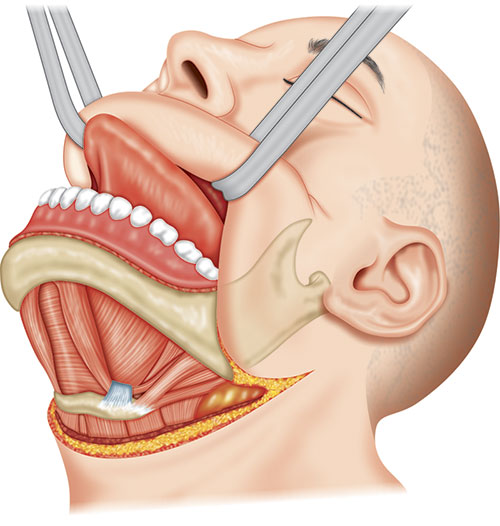

Composite Resection Surgery in Delhi NCR - Dr. Karan Gupta

When Is Composite Resection Needed?

Composite resection is recommended for selected patients with advanced oral cavity cancer when the tumour involves or lies very close to the jawbone and there is a significant risk of spread to the neck lymph nodes.

Confirmed oral cavity cancer involving or lying very close to the mandible (jawbone).
CT scan, MRI, or Dental OPG showing tumour invasion or erosion of the jawbone.
Primary tumour with confirmed or high-risk spread to the neck lymph nodes.
Recurrent oral cancer near the jaw after previous surgery, radiation therapy, or chemotherapy.

Important Clinical Note

Not every oral cancer located near the jaw requires removal of a segment of the jawbone. In many patients, a marginal mandibulectomy or a mandibulotomy performed only to improve surgical access is sufficient, allowing the jawbone to be preserved. The decision to remove part of the mandible is made only when there is confirmed bone invasion based on clinical examination and imaging studies. Every patient is evaluated individually to determine the most appropriate surgical approach while preserving normal function whenever possible.

When Is Composite Resection Needed?

Composite resection is generally recommended when oral cavity cancer, such as cancer of the tongue, buccal mucosa (inner cheek), gums, or floor of the mouth, directly involves or lies very close to the jawbone, and imaging or clinical staging shows a significant risk of nodal spread.

Confirmed Oral Cancer Diagnosis

A confirmed oral cavity cancer with tumour involvement of, or close proximity to, the mandible requiring careful surgical assessment.

Bone Invasion on Imaging

CT scan, MRI, or dental OPG demonstrating bone invasion or erosion by the tumour, indicating possible need for jaw resection.

Neck Lymph Node Spread

A primary oral tumour with confirmed or high-risk spread to the cervical lymph nodes, often requiring simultaneous neck dissection.

Recurrent Oral Cancer

Recurrent oral cancer involving the jaw region after previous surgery, radiation therapy, or chemotherapy may require composite resection.

Jaw Preservation Whenever Possible

Not every tumour near the jaw requires removal of a jaw segment. When there is no true bone invasion, procedures such as marginal mandibulectomy or mandibulotomy may preserve the jawbone.

Individualized Surgical Planning

The decision to remove part of the jaw is based on clinical examination, imaging findings, and tumour characteristics, ensuring every patient receives the most appropriate treatment.

What Composite Resection Involves

Composite resection is a comprehensive surgical procedure performed for advanced oral cancers. Depending on the extent of the disease, it may include tumour removal, jaw surgery, neck dissection, and immediate reconstruction to achieve complete cancer clearance while restoring function.

01

Removal of the Primary Tumour

The cancer is removed with an adequate margin of healthy tissue from the tongue, cheek, gum, or floor of the mouth, depending on the site of origin, to achieve complete tumour clearance.

02

Mandible Surgery

If the cancer has invaded the jawbone, a segmental mandibulectomy is performed. When there is no true bone invasion, a marginal mandibulectomy or mandibulotomy may be used to preserve jaw continuity whenever it is oncologically safe.

03

Neck Dissection

The lymph nodes in the neck are removed along with the primary tumour. The extent of neck dissection depends on the tumour location and the risk or presence of lymph node spread.

04

Reconstruction

Following tumour removal, reconstruction using local, regional, or microvascular free flaps is performed to restore the jaw, tongue, or soft tissues, helping improve appearance, chewing, swallowing, and speech.

Before Your Surgery: What to Expect

Before composite resection, Dr. Karan Gupta carefully reviews your biopsy reports, imaging, and pathology findings to plan the most appropriate surgical approach. Additional investigations, dental evaluation, and fitness assessments help ensure a safe procedure and successful reconstruction.

Comprehensive consultation and review of existing biopsy, imaging, and pathology reports
Assessment of your medical history, symptoms, and overall health condition
Additional staging investigations such as CT Scan, MRI, and Dental OPG to determine the extent of disease
Evaluation of jawbone and lymph node involvement for accurate surgical planning
Dental examination to identify and address any oral health concerns before surgery
Pre-anaesthesia fitness assessment, including routine blood tests and medical clearance
Instructions on stopping blood-thinning medications such as aspirin or ibuprofen, if advised by your surgeon
Discussion of the planned extent of tumour removal and jaw surgery, if required
Explanation of the reconstruction technique and expected functional outcomes
Detailed counselling about the surgical procedure, hospital stay, recovery timeline, and post-operative care

Why Choose Dr. Karan Gupta for Composite Resection in Delhi NCR

Dr. Karan Gupta combines advanced surgical expertise, international robotic surgery training, and a multidisciplinary approach to deliver comprehensive care for patients with advanced oral and head & neck cancers requiring composite resection surgery.

Fellowship-Trained Surgical Oncologist

Advanced fellowship training in Head & Neck Surgical Oncology at Tata Memorial Hospital, Mumbai, and HCG Cancer Centre, Ahmedabad.

International Robotic Surgery Training

Further trained in Robotic Head & Neck Surgery through the Vattikuti Foundation, Michigan, USA, offering advanced minimally invasive surgical expertise.

Certified Robotic Head & Neck Surgeon

Intuitive Surgical USA Certified Robotic Head & Neck Surgeon with expertise in modern surgical techniques for complex head & neck cancers.

Triple Gold Medalist

Recipient of Triple Gold Medals across MBBS, MS, and DNB, reflecting outstanding academic excellence and surgical proficiency.

Comprehensive Multidisciplinary Care

Composite resection is planned as part of a complete surgical and reconstructive strategy, coordinated with a multidisciplinary team to optimize cancer control, function, and long-term recovery.

Frequently Asked Questions

Find answers to common questions about composite resection surgery, commando operation, jaw reconstruction, neck dissection, recovery, rehabilitation, and treatment planning for advanced oral cancer.

Composite resection, historically known as the commando operation, is a surgery for advanced oral cancer that removes the primary tumour, a portion of the jawbone (mandible) when it is involved by the cancer, and the lymph nodes in the neck during the same operation. It combines tumour removal, mandible surgery, and neck dissection into one comprehensive procedure.

In most cases, yes. Removing the tumour along with part of the jawbone or a large portion of the tongue or cheek usually creates a defect that requires reconstruction to restore appearance, chewing, swallowing, and speech. Reconstruction is commonly performed during the same surgery using local, regional, or microvascular free flap techniques.

Speech and swallowing are usually affected during the initial recovery period. The extent of recovery depends on how much tissue and bone were removed and the type of reconstruction performed. A feeding tube may be needed temporarily, while speech and swallowing rehabilitation helps patients regain function as fully as possible.

This depends on the final pathology report, including tumour size, surgical margins, bone involvement, and whether cancer has spread to the lymph nodes or beyond them. Your case is reviewed by a multidisciplinary cancer team, and additional radiation therapy or chemotherapy is recommended only when clinically indicated.

Yes. Composite resection includes neck dissection as one of its essential components because advanced oral cancers involving the jaw have a significant risk of spreading to the lymph nodes. The extent of neck dissection depends on the stage of the cancer and imaging findings.

Hospital stay is generally longer than for smaller oral cancer surgeries because composite resection involves tumour removal, jaw surgery, neck dissection, and reconstruction. During this time, your surgical team closely monitors wound healing, flap viability, airway safety, and recovery. Your surgeon will provide an expected hospital stay based on the extent of your surgery.
Composite Resection Surgery