Neck Dissection Explained: What Gets Removed, What Doesn't, and What Recovery Feels Like
It's a common moment in a head
& neck cancer consultation: the surgeon has just explained the plan for the
main tumour, and then adds that a neck dissection will be done at the same
time. For a lot of patients, this is the part that raises more questions than
the main surgery itself — because "dissection" sounds far more
drastic than most people expect, and it's rarely explained in plain terms
before the consent form arrives.
This is written for that moment.
Not to replace what your surgeon tells you, but to give you a clearer starting
point — so the conversation in clinic is about your specific case, not about
basic terminology.
Why a neck dissection is often needed alongside the main surgery
Head & neck cancers —
including those starting in the mouth, throat, and thyroid — commonly spread
first to lymph nodes in the neck before spreading anywhere else. A neck
dissection removes the lymph node groups most likely to contain cancer cells, either
because imaging or examination has already shown involvement, or because the
primary tumour carries a high enough risk of silent spread that removing those
nodes preventively is considered the safer path.
It's a separate procedure from
removing the primary tumour, but it's almost always done in the same operation,
through the same general surgical window, rather than as a second surgery
later.
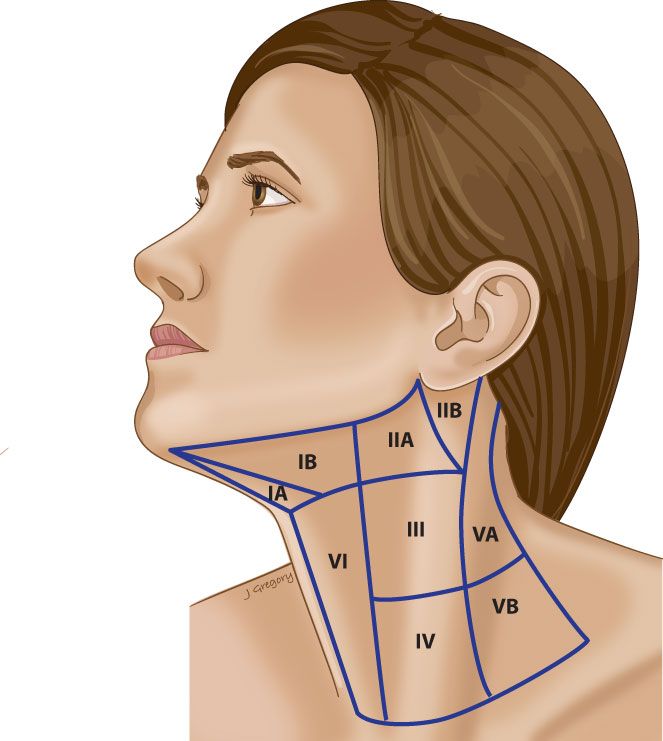
The neck's lymph node levels — the map surgeons work from
Surgeons describe the neck's
lymph nodes in five main levels (I through V), running roughly from under the
jaw down to the collarbone. Which levels get removed depends entirely on where
your primary tumour is and which levels its lymphatic drainage typically
reaches first — a mouth cancer and a thyroid cancer, for instance, put
different node groups at risk.
The three main types of neck dissection
Neck dissections aren't one
standard operation — they range from removing a small, targeted set of node
levels to a more extensive clearance. What differs across the three main types
isn't just how many lymph nodes come out, but whether three specific non-lymphatic
structures are removed or preserved: the sternocleidomastoid muscle (a major
neck muscle), the internal jugular vein, and the spinal accessory nerve, which
controls part of shoulder movement.
|
Type |
Lymph
Node Levels |
Non-Lymphatic
Structures |
When
It's Typically Used |
|
Selective neck dissection |
Removes only the specific level(s) at risk, not all five |
Sternocleidomastoid, jugular vein, and accessory nerve are
all preserved |
Node-negative necks with meaningful risk of silent spread,
or limited node involvement |
|
Modified radical neck dissection |
Removes levels I–V |
Preserves one, two, or all three non-lymphatic structures,
depending on sub-type (I, II, or III) |
Confirmed node involvement, without the disease invading
these structures |
|
Radical neck dissection |
Removes levels I–V |
All three structures (muscle, vein, and nerve) are removed |
Extensive nodal disease where cancer has grown into these
structures directly |
Radical
neck dissection was the original, most extensive version of this operation,
developed in the early 1900s. It's used far less often today — most patients
having a neck dissection now undergo a selective or modified radical version,
which removes far fewer non-cancerous structures while still clearing the
at-risk nodes.
What this means for your body, structure by structure
The lymph nodes themselves
Once removed, the nodes are
examined under a microscope to confirm how many, if any, contain cancer cells.
This pathology result often shapes decisions about further treatment, such as
radiation, so the neck dissection is diagnostic as well as therapeutic.
Sternocleidomastoid muscle
This is the long muscle running
from behind the ear down to the collarbone that lets you turn your head. When
preserved, most patients regain close to normal neck rotation. When it's
removed (as in a radical dissection), neck contour and rotation are more
noticeably affected, though the remaining neck muscles compensate to a
meaningful degree over time.
Internal jugular vein
One of the major veins draining
blood from the head and neck. The body generally tolerates removal of one
jugular vein well, since blood flow reroutes through other vessels. It's
preserved whenever oncologically safe to do so.
Spinal accessory nerve — the one that affects daily life most
This nerve controls part of the
trapezius muscle, which lifts the arm above shoulder height and stabilises the
shoulder blade. It's the structure most responsible for what surgeons call
"shoulder syndrome" when it's injured, stretched, or removed — an
achy, stiff shoulder with difficulty raising the arm fully. Even when the nerve
is carefully preserved, some degree of temporary shoulder stiffness is common,
because the area around it is still disturbed during surgery.
What recovery actually feels like
Recovery timelines vary by
extent of surgery and whether the neck dissection was combined with
reconstruction, but a general pattern holds for most patients.
|
Recovery
Milestone |
What's
Typical |
|
Hospital stay |
Several days, largely driven by the main tumour surgery
rather than the neck dissection alone |
|
Surgical drain |
Usually stays in for some days after surgery, removed once
fluid output drops to a low level |
|
Numbness |
Common along the neck, ear, and jaw edge — related to
small sensory nerves that are unavoidably affected; often improves gradually
over months, though some numbness can be permanent |
|
Shoulder stiffness/weakness |
If the accessory nerve was stretched or handled, aching
and reduced overhead reach are common early on; physiotherapy is central to
recovery here |
|
Return to light daily activity |
Typically within a few weeks, guided by your surgical team
based on healing and any combined reconstruction |
|
Scar appearance |
Usually settles and fades over months; final appearance
depends on incision design and individual healing |
Shoulder physiotherapy — why it matters even if the nerve was preserved
This is one of the most
under-discussed parts of neck dissection recovery. Research using
electromyography (a test that measures muscle electrical activity) has shown
measurable reductions in trapezius muscle activity after neck dissection even
when the spinal accessory nerve is anatomically preserved — the manipulation
involved in the surgery itself can still affect how well the nerve functions
afterward, at least temporarily.
This is exactly why structured
shoulder physiotherapy — starting with gentle range-of-motion exercises and
progressing gradually — is now considered a standard part of recovery, not an
optional add-on. Most patients see meaningful improvement in shoulder function
over the weeks and months following surgery when physiotherapy is followed
consistently.
Questions worth asking before your surgery
- Which specific lymph node levels are planned for
removal in my case, and why those?
- Is this a selective, modified radical, or radical neck
dissection, and what's the reasoning?
- Is the spinal accessory nerve expected to be preserved,
and what happens if it can't be during surgery?
- Will I be referred for shoulder physiotherapy, and when
should that start?
- Will this be on one side of my neck or both, and does
that change the recovery expectations?
Frequently Asked Questions
Does removing lymph nodes from my neck mean the cancer has definitely spread?
Not necessarily. A neck
dissection is sometimes done preventively when a tumour carries a meaningful
risk of silent spread, even if nothing has been detected on imaging. The nodes
removed are examined afterward to confirm the actual finding.
Will I lose full movement of my neck and shoulder permanently?
Most patients regain a good range of neck
and shoulder movement, particularly when the sternocleidomastoid muscle and
spinal accessory nerve are preserved, which is the case in the majority of
dissections performed today. Some residual stiffness or reduced overhead reach
is possible and physiotherapy meaningfully improves outcomes.
Is neck dissection a separate surgery from my main cancer surgery?
Usually not — it's typically performed
in the same operation as the removal of the primary tumour, through a
coordinated surgical plan, rather than as a separate procedure on a different
day.
How long does the numbness in my neck and ear last?
This varies. Many patients notice gradual improvement
over several months as small sensory nerves recover, though some degree of
numbness in the area, particularly around the earlobe, can be long-term for
some patients.
Will I need radiation after a neck dissection?
That depends on what the pathology of the removed lymph
nodes shows — factors like the number of nodes involved and whether cancer has
spread beyond the node capsule influence this decision, and it's made after
reviewing the full pathology report, not before.
Before your surgery
If a neck dissection has been
recommended alongside your main procedure, it's worth asking your surgical team
to walk through exactly which levels and structures are involved in your
specific plan — the general picture above is a starting point, not a substitute
for that conversation. Bringing your imaging and biopsy reports to that
discussion, or to a second opinion beforehand, tends to make it a far more
specific and useful conversation.