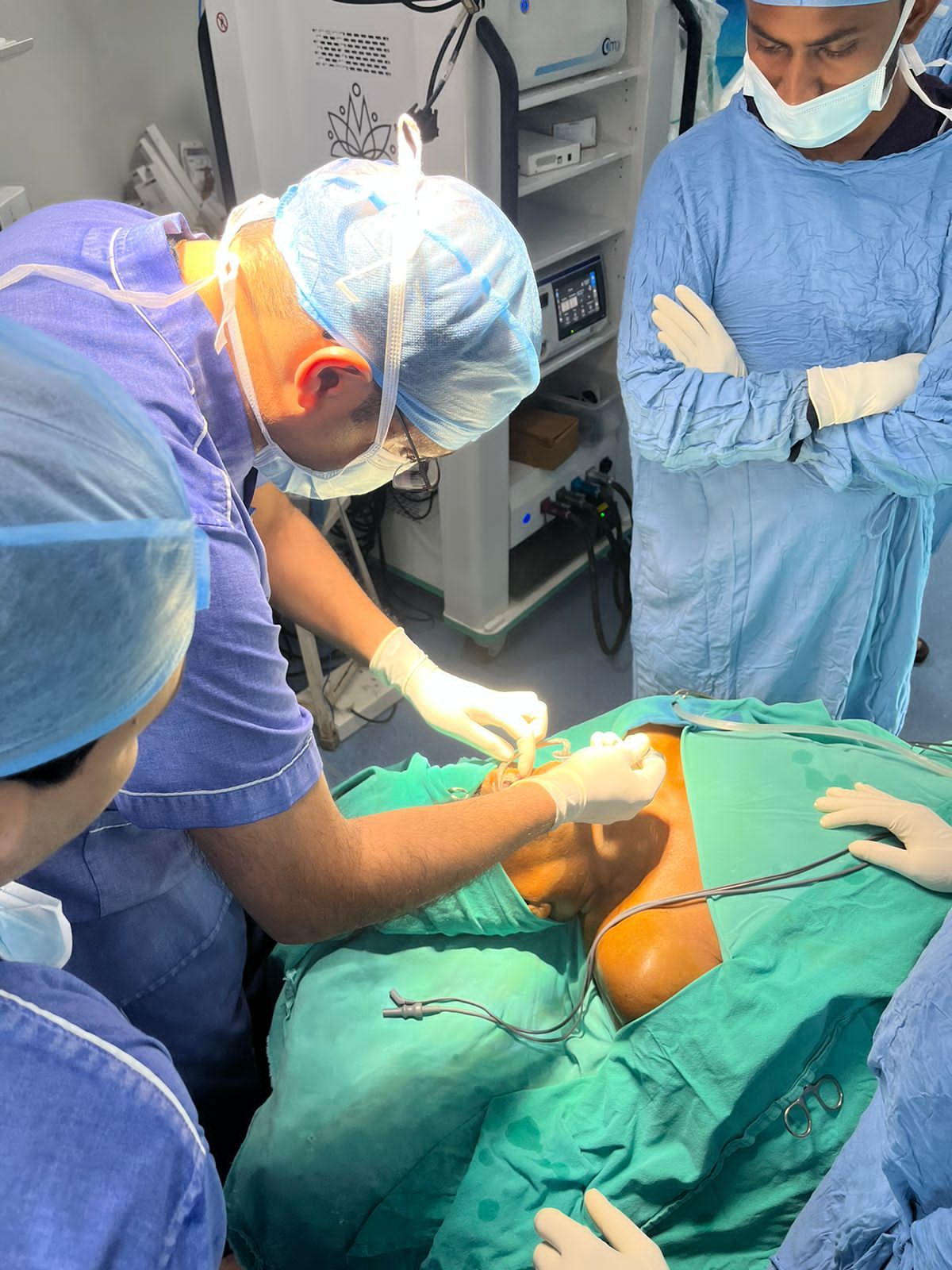
Comprehensive surgical care for cancers and other disorders affecting the larynx (voice box) and hypopharynx. Dr. Karan Gupta offers advanced treatment options, including transoral laser microsurgery (TLM), transoral robotic surgery (TORS), partial laryngectomy, total laryngectomy, voice-preserving surgery, and neck dissection, with treatment tailored to achieve the best possible cancer control while preserving speech and swallowing whenever appropriate.
Please fill out the form below to book your consultation layer.
When laryngeal or hypopharyngeal cancer is too advanced for voice-preserving options, or when it returns after radiation, total laryngectomy offers a definitive surgical solution. Dr. Karan Gupta, a fellowship-trained Head & Neck Oncosurgeon, performs total laryngectomy in Delhi NCR, including salvage surgery after failed radiation, with neck dissection and reconstruction planned in the same operation when needed, and a clear plan for voice and swallowing rehabilitation from the outset.
Total laryngectomy is the complete surgical removal of the larynx (voice box). It is usually recommended for advanced laryngeal cancer, selected hypopharyngeal cancers, or recurrent disease after radiation therapy when organ-preserving treatments are no longer suitable.
Because the larynx normally separates the airway from the swallowing passage, removing it means these two pathways must be permanently separated. During surgery, the windpipe is brought out to a new opening in the lower neck, called a stoma, through which you breathe, while the throat is reconstructed to allow food and saliva to pass safely into the food pipe.
Total laryngectomy is one of the advanced treatment options within comprehensive larynx and hypopharynx cancer surgery. Depending on the extent of disease, surgery may also include neck dissection, pharyngeal reconstruction, and rehabilitation for speech and swallowing to help patients regain the best possible quality of life after treatment.
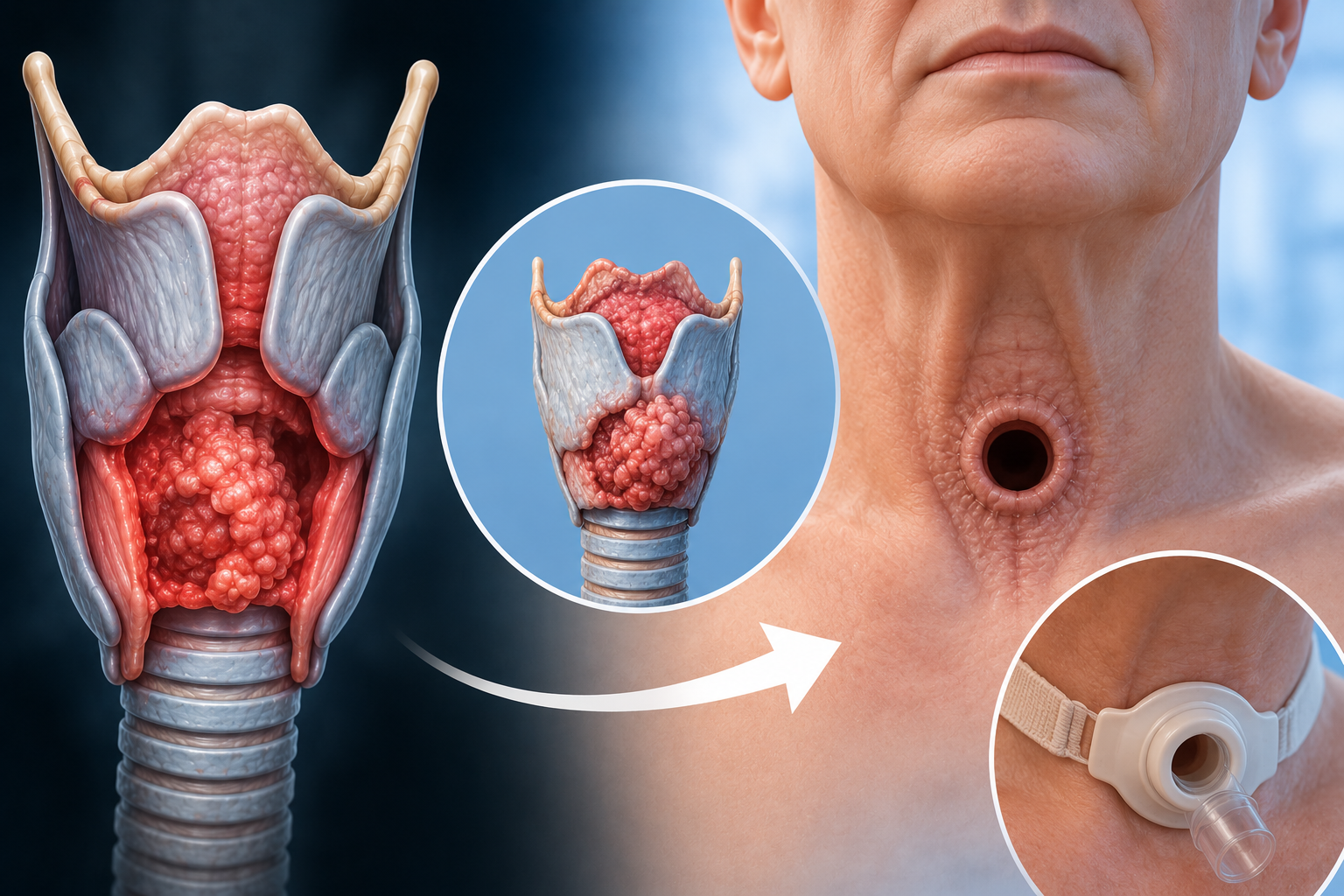
Total laryngectomy is generally recommended when preserving the voice box is no longer possible or would compromise complete cancer removal. Dr. Karan Gupta evaluates each patient using detailed laryngoscopy, imaging, and cancer staging to determine the safest and most effective treatment approach.
Cancer affecting both vocal cords with fixed or severely impaired movement usually requires total laryngectomy to achieve complete tumour removal.
When cancer has invaded the cartilage framework of the larynx, organ-preserving surgery is usually not suitable, making total laryngectomy the preferred treatment.
Larger laryngeal cancers that cannot be completely removed while preserving the voice box are best treated with total laryngectomy.
Cancer that recurs or persists after radiation therapy, with or without chemotherapy, often requires salvage laryngectomy for definitive treatment.
Advanced hypopharyngeal cancers that involve the larynx frequently require total laryngectomy with or without reconstruction and neck dissection.
For smaller, earlier-stage cancers, voice-preserving surgery or radiation may be more appropriate. The best treatment is decided after detailed laryngoscopy, imaging, and cancer staging.
Recovery after total laryngectomy takes longer than after voice-preserving surgery and requires careful monitoring for wound healing, swallowing, breathing, and long-term voice rehabilitation. Dr. Karan Gupta provides comprehensive postoperative care to support a safe recovery and the best possible quality of life.
A feeding tube is used temporarily while the reconstructed throat heals. Oral feeding is gradually restarted once healing is confirmed and swallowing is considered safe.
Patients receive early education on stoma care, including cleaning, humidification, and daily maintenance, as breathing permanently takes place through the neck stoma rather than the nose or mouth.
The reconstructed throat is monitored closely for complications such as a pharyngocutaneous fistula (leak), which is especially important in patients undergoing salvage laryngectomy after radiation therapy.
Once healing allows, voice rehabilitation begins—most commonly using a tracheoesophageal puncture (TEP) with a voice prosthesis—in close coordination with a speech-language pathologist.
The final pathology report is reviewed after surgery to determine whether additional treatment, such as radiation therapy, is recommended to reduce the risk of cancer recurrence.
Careful planning before total laryngectomy helps ensure the safest surgery and prepares you for recovery, breathing through a stoma, and voice rehabilitation. Dr. Karan Gupta performs a thorough evaluation and discusses every aspect of treatment so you know what to expect before and after surgery.
Your consultation includes detailed laryngoscopy, review of the biopsy report, and assessment of your previous treatment history, including any prior radiation or chemotherapy.
Advanced imaging such as CT, MRI, or PET-CT is performed to accurately determine the extent of the cancer and help plan the surgical approach.
Before surgery, you will receive counselling about breathing through a permanent stoma, stoma care, and voice rehabilitation options such as a tracheoesophageal voice prosthesis.
A pre-anaesthesia evaluation, blood investigations, and nutritional assessment are carried out to ensure you are medically fit for surgery and prepared for temporary tube feeding during recovery.
Dr. Karan Gupta explains whether neck dissection, pharyngeal reconstruction, or other procedures will be performed alongside the total laryngectomy and discusses the expected recovery and rehabilitation plan.
Total laryngectomy is a major surgical procedure, and like any complex cancer surgery, it carries certain risks and long-term lifestyle changes. Dr. Karan Gupta discusses these in detail before surgery so that you and your family can make a well-informed treatment decision.
As with any major operation, there is a risk of bleeding, infection, wound-related complications, and delayed healing. Every precaution is taken to minimise these risks throughout your treatment.
A leak at the throat closure site (pharyngocutaneous fistula) is a recognised complication, particularly in patients undergoing salvage laryngectomy after previous radiation therapy.
Over time, the permanent breathing opening (stoma) may narrow (stenosis), requiring ongoing care and, in some cases, additional treatment to maintain adequate airflow.
Because breathing no longer occurs through the nose, patients may notice reduced smell and changes in taste. Rehabilitation techniques can help improve these functions over time.
Total laryngectomy permanently removes the natural voice and requires lifelong breathing through a neck stoma. These life-changing effects are discussed thoroughly before surgery, along with voice rehabilitation options such as a tracheoesophageal voice prosthesis. When appropriate, reconstruction and additional tissue support are planned to reduce complications. If you would like an independent review of your reports and imaging before deciding on surgery, Dr. Karan Gupta also offers a second opinion consultation.
Dr. Karan Gupta combines advanced fellowship training, extensive experience in head & neck cancer surgery, and a patient-focused rehabilitation approach to deliver comprehensive care for advanced laryngeal and hypopharyngeal cancers. From surgical planning to voice restoration, swallowing recovery, and long-term stoma care, every stage of treatment is carefully coordinated to achieve the best possible outcomes.
Fellowship-trained in Head & Neck Surgical Oncology at Tata Memorial Hospital, Mumbai, and HCG Cancer Centre, Ahmedabad, with expertise in complex laryngeal and hypopharyngeal cancer surgery.
Further trained in Robotic Head & Neck Surgery through the Vattikuti Foundation, Michigan, USA, with advanced expertise in modern head & neck cancer surgical techniques.
Intuitive Surgical USA Certified Robotic Head & Neck Surgeon, offering evidence-based surgical care for patients with advanced laryngeal cancers.
Recipient of Triple Gold Medals across MBBS, MS, and DNB, reflecting exceptional academic excellence and dedication to surgical precision.
Every total laryngectomy is planned with a structured rehabilitation pathway from the outset, including voice restoration, swallowing rehabilitation, and lifelong stoma care. This comprehensive approach supports recovery and quality of life, making Dr. Karan Gupta a trusted choice for patients seeking an experienced total laryngectomy surgeon in Delhi NCR.
Find answers to common questions about total laryngectomy, salvage surgery after radiation, stoma care, voice rehabilitation, and recovery for advanced laryngeal and hypopharyngeal cancer by Dr. Karan Gupta.