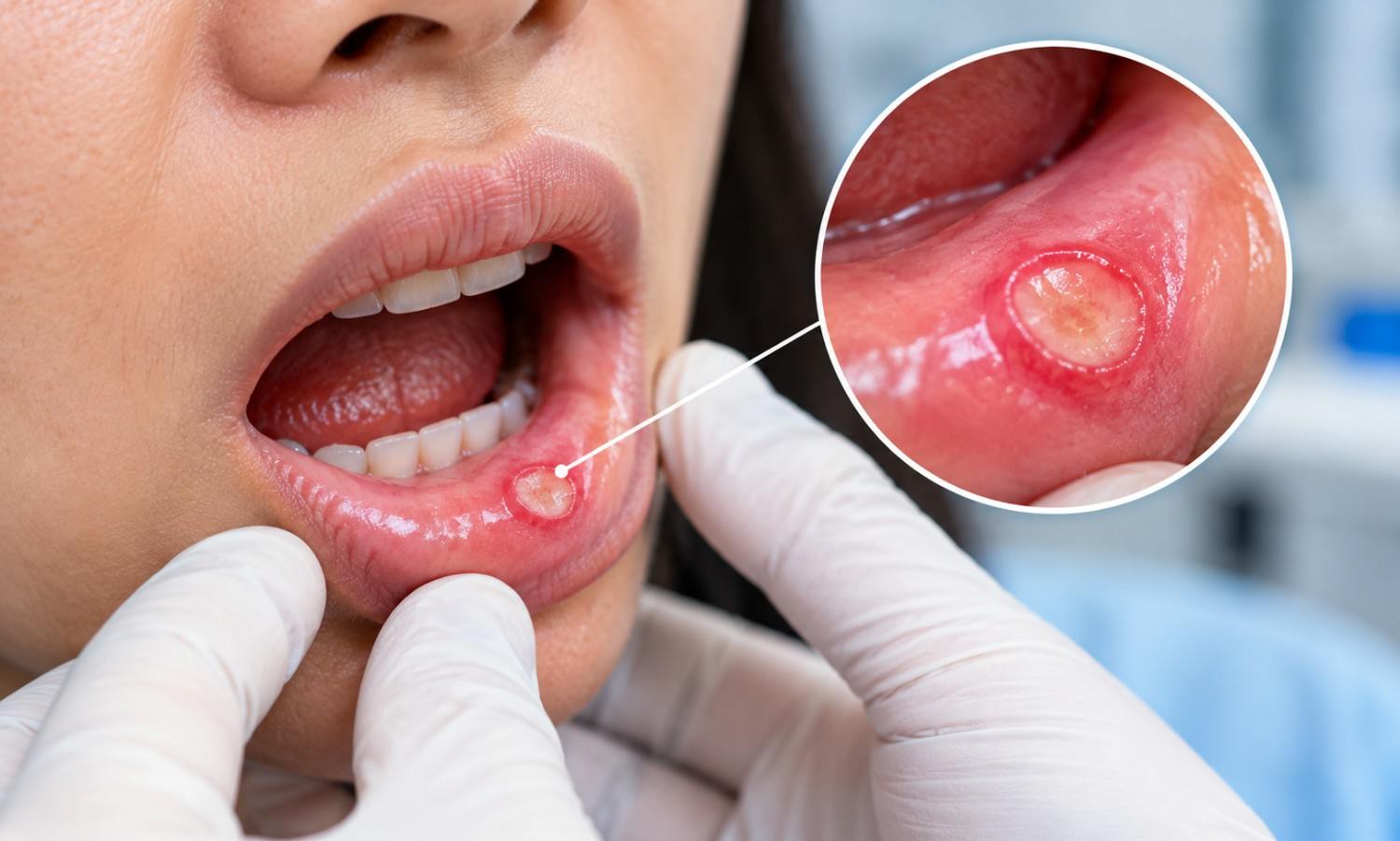
Persistent Mouth Ulcer: When Should You See an Oral Cancer Specialist?
Most mouth
ulcers are not cancer. The common canker sore usually heals by itself within a
week or two. But a persistent mouth ulcer, meaning one that has not
healed after about two weeks, keeps getting bigger, or keeps returning in the
same spot, should be examined in person. Persistent or worsening lesions may
need further evaluation, and a biopsy may be recommended when it is clinically
indicated.
That is not a
prediction that cancer is likely; it is a way of making sure a sore that
behaves differently from a normal ulcer gets explained. This guide covers
normal healing, red flags, what an examination involves, and which doctor to
start with, including when to see an oral cancer specialist in Delhi NCR.
|
Quick
answer: when to get a mouth ulcer checked •
See a dentist or doctor if a mouth
ulcer has not healed in about 2 weeks, or sooner if it is growing, bleeding
or unusually firm. •
See a head and neck cancer specialist promptly if the sore is
lasting alongside a red or white patch, a lump, numbness, trouble swallowing
or moving the tongue, or a lump in the neck, especially if you use tobacco or
areca nut. •
Do not self-treat indefinitely. If home care
has not worked in two weeks, examination is the next step. |
What Is a Persistent Mouth Ulcer?
A persistent
mouth ulcer is a sore or break in the lining of the mouth that has not healed
within about two weeks, or that keeps coming back in the same place. It may
be painful or painless. Persistence is a signal to look for a cause; it is not
a diagnosis in itself.
People also
describe it as a non-healing mouth ulcer or a mouth sore that won’t heal. It
can appear on the tongue, inner cheek, gums, floor or roof of the mouth, or
lips.
How Long Does a Normal Mouth Ulcer Take to Heal?
Most minor
mouth ulcers heal on their own in about one to two weeks. Ulcers caused by
a cheek bite, a burn or a rough tooth edge often settle within a week once the
cause is gone. The usual pattern looks like this:
•
It is most uncomfortable in the first few days.
•
It then shrinks and becomes less painful.
•
It fades completely, usually leaving no mark.
Larger canker
sores can take longer, so duration alone cannot separate harmless from
concerning. As a practical rule, an ulcer in the mouth for more than 2 weeks
with no clear explanation is past the normal window, and an ulcer in the
mouth for 3 weeks should be examined without further waiting. The American
Cancer Society likewise advises seeing a doctor or dentist when mouth symptoms
last beyond two weeks (ACS).
When Should You See a Doctor for a Mouth Ulcer?
Book an
examination if a mouth ulcer has not healed in about two weeks, or if it has
any of the features below. Many are listed by the American Cancer Society
as possible signs of oral cavity cancer, though most have other causes (ACS).
•
Persistence: the ulcer is not healing, or heals
and returns in the same spot.
•
Growth: it is getting larger, deeper or harder.
•
Bleeding: it bleeds easily or without any
injury.
•
Pain pattern: pain that does not settle, or a
sore that is painless but still not healing.
•
Patches: a red patch, a white patch, or a mix of
both nearby.
•
Lump or thickening: a hard or thickened area in
the mouth, cheek or lip.
•
Numbness: reduced feeling in the tongue, lip or
cheek.
•
Function: difficulty chewing, swallowing, moving
the tongue, or opening the mouth fully.
•
Teeth and dentures: a tooth that has become
loose for no dental reason, or dentures that suddenly stop fitting.
•
Neck: a lump or swelling in the neck.
Trouble
swallowing, bleeding without injury, or a new neck lump are reasons to be seen
sooner than the two-week mark.
Does a Persistent Mouth Ulcer Mean Oral Cancer?
No. Most
mouth ulcers are not cancer, and most persistent ulcers also have a non-cancer
cause, such as ongoing irritation from a sharp tooth or denture.
Still, a sore
in the mouth that does not heal is the first symptom the American Cancer
Society lists for oral cavity cancer (ACS).
That is why a mouth ulcer and oral cancer are linked in people’s minds,
and why a lasting ulcer should not be left to “wait and see”. Appearance alone
cannot settle it; examination, and sometimes tissue testing, does.
What Causes a Mouth Ulcer That Won’t Heal?
A non-healing
ulcer in the mouth has many possible causes; cancer is one among several.
•
Trauma: a sharp or broken tooth, rough filling,
or repeated cheek or tongue biting.
•
Dentures and appliances: rubbing from loose
dentures, braces or retainers.
•
Irritation: very hot, spicy or acidic food, or
harsh mouthwashes.
•
Infection: viral, fungal (such as candida) and,
less often, bacterial, including tuberculosis or syphilis.
•
Nutritional deficiency: low iron, vitamin B12 or
folate.
•
Inflammatory and immune conditions: for example
lichen planus, pemphigus or Behçet disease.
•
Medicines: some drugs list mouth ulcers as a
side effect.
•
Tobacco and areca nut irritation: chronic
exposure damages the mouth lining.
•
Potentially malignant disorders: leukoplakia
(white patch), erythroplakia (red patch) and oral submucous fibrosis can become
cancer over time.
•
Oral cancer: less common, but the one most
important not to miss.
The cause often
cannot be identified without examination; two similar-looking ulcers can have
different explanations.
What Does an Oral Cancer Ulcer Look Like?
There is no
single look. Some early lesions resemble an ordinary ulcer or patch, so
appearance alone cannot confirm or exclude cancer. Features that make a doctor
more cautious include:
•
raised, rolled or hard edges, or a firm, thickened base
•
easy bleeding
•
a surrounding red or white patch
•
a site on the side or underside of the tongue, floor of
mouth or inner cheek
•
no improvement over two weeks despite removing likely
irritants
None of these
proves cancer, and a lesion without them can still need testing, so photographs
are no substitute for examination.
Risk Factors for Oral Cancer
Risk factors
raise likelihood but do not predict it; some people with several never develop
oral cancer, and some with none do (ACS).
•
Smoked tobacco: cigarettes, bidis, cigars, pipes
and hookah; risk generally rises with amount and duration.
•
Smokeless tobacco: chewing tobacco, khaini and
gutka sit directly against the mouth lining.
•
Areca nut (betel nut) and betel quid: common in
India as supari, paan and many gutka blends. The International Agency for
Research on Cancer classifies betel quid, with or without tobacco, as
carcinogenic to humans (IARC Monographs, Volume 85). Long-term use can also
cause oral submucous fibrosis, which stiffens the mouth lining and makes
opening the mouth difficult.
•
Alcohol: risk rises with heavier drinking, and
tobacco plus alcohol raises it more than either alone (ACS).
•
HPV: more strongly linked with cancers at the
back of the throat (oropharynx) than the front of the mouth.
•
Other factors: older age, sun exposure (for lip
cancer) and a weakened immune system.
Because tobacco
and areca nut use are widespread in India, a persistent ulcer in someone with
this history deserves earlier attention. Stopping these habits lowers risk over
time.
Why Pain Is Not a Reliable Test
A painless
ulcer is not automatically harmless. Early oral cancers can cause little or
no pain, while many harmless canker sores hurt a great deal. The sore that
hurts may be the one that is settling, and the quiet one may need attention.
What matters
more is the pattern: improving, unchanged or growing. A painless persistent
mouth ulcer that is not improving is as good a reason to book an
examination as a painful one.
What Happens When You See an Oral Cancer Specialist?
A head and neck
cancer specialist works through a structured assessment. Not every step is
needed for every patient; many people are examined, reassured and given a
simple plan.
1.
Medical and dental history: existing conditions,
medicines and recent dental work.
2.
Questions about the ulcer: when it started,
whether it is changing, what you have tried, and tobacco, areca nut or alcohol
use.
3.
Oral examination: inspecting and gently feeling
the lesion in good light.
4.
Surrounding structures: tongue (including sides
and underside), gums, cheeks, floor and roof of the mouth, lips and teeth.
5.
Neck examination: checking lymph nodes when
appropriate.
6.
Further tests when clinically indicated: for
example blood tests for deficiencies, or swabs if infection is suspected.
7.
Biopsy when required: a small tissue sample for
pathology (see below).
8.
Imaging and staging: MRI, CT or PET-CT only if
cancer is diagnosed or strongly suspected, to see how far it extends.
Bring your
medicines list, earlier dental or medical records, and a few dated phone
photographs showing how the sore has changed.
Is a Biopsy Necessary for Every Persistent Mouth Ulcer?
No. A biopsy
is not automatically needed for every ulcer. When a clear irritant such as
a sharp tooth is found, the specialist may remove it and review the ulcer after
a week or two. A biopsy is usually considered when:
•
the ulcer has no obvious cause, or has not healed once
the likely cause is dealt with
•
it has suspicious features such as hardness, a mixed
red and white patch, or easy bleeding
•
it is growing, or comes with numbness or a neck lump
Biopsy is the
definitive method for establishing a tissue diagnosis when malignancy is
suspected. A small sample, often taken under local anaesthetic, is examined by
a pathologist. The American Dental Association’s guideline likewise points to a
thorough clinical examination first, with biopsy or referral for lesions that
remain suspicious (ADA).
If a first sample is inconclusive, a repeat sample or close follow-up may be
advised.
Dentist, ENT, Oral Medicine Specialist or Head & Neck Oncologist: Where Should You Start?
A dentist or
doctor can make the first assessment and refer you if needed. For a lesion that
is lasting or looks suspicious, going straight to a head and neck surgical
oncologist is also reasonable. Oral and maxillofacial surgeons and ENT head and
neck surgeons also treat oral cancer, so treat the table as a guide, not a
rule.
|
Who |
A good starting point when |
What they typically do |
|
Dentist |
The
ulcer is near a sharp tooth, filling or denture; you want a quick first look. |
Examines
the mouth, removes or smooths irritants, reviews healing, refers if the
lesion persists. |
|
Oral medicine specialist / oral
& maxillofacial surgeon |
Recurrent ulcers, patches, suspected
immune or inflammatory cause, or a lesion needing biopsy. |
Diagnoses mouth-lining conditions,
takes biopsies, manages non-cancerous disease. |
|
ENT specialist |
Ulcer
with throat symptoms, hoarseness, ear pain or a neck swelling. |
Examines
the mouth, throat and neck; arranges tests; refers when cancer is suspected. |
|
Head & neck surgical
oncologist |
Ulcer persisting after irritants are
fixed, red-flag features, suspected or confirmed cancer, or a second opinion
on a biopsy or scan. |
Examines and biopsies suspicious
lesions, stages cancer, plans and performs surgery including neck dissection
and reconstruction. |
Persistent Mouth Ulcer vs Common Canker Sore
The comparison
below describes typical patterns only. It cannot be used to diagnose cancer or
rule it out.
|
Feature |
Common canker sore |
Persistent mouth ulcer (needs evaluation) |
|
Usual healing pattern |
Heals
on its own in about 1–2 weeks |
Not
healed after about 2 weeks, or slow, stalled healing |
|
Persistence |
Gone within days to two weeks |
Stays, or keeps coming back in the same
spot |
|
Recurrence |
May
recur in different places from time to time |
Recurs
in the same place, or leaves a lump or patch behind |
|
Appearance |
Small, round or oval, pale centre with
a red rim |
Variable: may be raised, hard-edged,
bleeding, or within a red or white patch |
|
Pain |
Often
noticeably painful early on, then easing |
May
be painful or painless; pain is not a reliable guide |
|
Associated symptoms |
Usually none |
Possible numbness, lump, trouble
chewing or swallowing, loose tooth, neck lump |
|
When to be evaluated |
If
very frequent, very large or unusually slow |
Examine
at about 2 weeks, sooner if any red flag is present |
Can Oral Cancer Be Detected Early?
The inside of
the mouth is visible and reachable, so changes can often be seen and felt. The
American Dental Association’s guideline identifies a comprehensive clinical
oral examination as the most important first step in finding early signs of
oral and lip cancers (ADA).
Early detection
depends on the person getting a change examined and the clinician recognising
when tissue testing is needed. No test or doctor can offer guarantees; outcomes
depend on the cancer’s type, site and stage and on the individual. Timely
assessment is the step within your control.
Why Early Evaluation Matters
Getting a
lasting ulcer examined is useful whatever the result:
•
Benign causes get fixed, such as a sharp tooth,
denture edge or deficiency, so the sore can heal.
•
Potentially malignant disorders are found while
they can be monitored or treated.
•
If cancer is present, diagnosis is not delayed,
so treatment planning can begin sooner.
•
Treatment is matched to the findings; earlier,
smaller problems generally need less extensive treatment (NCI).
Why Choose Dr. Karan Gupta for Oral Cancer Evaluation in Delhi NCR?
When choosing
an oral cancer specialist in Delhi NCR, the checklist on Dr. Gupta’s own
Oral
Cancer page is a fair way to compare any surgeon: formal head and neck
oncology training, focus on oral cavity cancer, neck dissection and
reconstruction capability, and clear communication. The details below are as
published on his official website.
•
Qualifications: MBBS (Gold Medal), Maulana Azad
Medical College, Delhi; MS Otolaryngology–Head & Neck Surgery (Gold Medal),
PGIMER, Chandigarh; DNB Otolaryngology (Gold Medal).
•
Oncology training: fellowships in head and neck
oncology at HCG Cancer Centre, Gujarat and Tata Memorial Hospital, Mumbai;
robotic head and neck surgery fellowship through the Vattikuti Foundation;
Intuitive Surgical USA-certified; observerships at Mount Sinai (Toronto), Stanford
and Memorial Sloan Kettering.
•
Relevant services: examination and biopsy of
suspicious oral lesions, oral
cavity cancer surgery, neck
dissection, composite
resection, reconstruction
after cancer surgery, and review
of biopsy, scans and reports for a second opinion.
Robotic surgery
suits only selected cancers; the approach is decided case by case. A lasting
mouth ulcer is first about examination, not surgery, and most people who come
with one will not need an operation.
Dr. Gupta
consults at Apollo Athenaa Cancer Centre, Defence Colony, New Delhi (Monday to
Saturday, 9:00 AM to 2:00 PM) and Apollo Miracles Hospital, Sector 14, Gurugram
(Tuesday and Friday, 5:30 PM to 7:30 PM), as listed on the website. Please
confirm timings when booking.
|
Have
a mouth ulcer that isn’t healing? If you have a mouth ulcer or oral
lesion that is not healing, an in-person examination can help determine the
cause and whether further evaluation is needed. Consider getting it examined
rather than continuing to self-treat. •
Book an appointment with a head and neck cancer specialist
in Delhi NCR •
Call the appointment helpline: +91 98111 22341 •
Message on WhatsApp •
Already have a biopsy or scan report? Request a second opinion |
A persistent
mouth ulcer is usually explained by something simple, but the only way to know
is to look. If yours has gone past two weeks, it is reasonable to have it
examined, whether by your dentist first or directly by an oral cancer doctor in
Delhi.
Frequently Asked Questions
How long is too long for a mouth ulcer?
Most minor
ulcers heal within one to two weeks. One that has not clearly improved after
about two weeks, or three weeks at most once an obvious cause such as a sharp
tooth is removed, should be examined by a dentist or doctor.
Can a persistent mouth ulcer be oral cancer?
It can,
although most are not cancer. A sore that does not heal is a well-known symptom
of oral cavity cancer, but irritation, infection, deficiencies and inflammatory
conditions are more common causes. Only examination, and sometimes a biopsy,
can tell them apart.
What does a cancerous mouth ulcer look like?
There is no
single appearance. Some are small, shallow sores; others have raised or hard
edges, bleed easily, or sit within a red or white patch. Many harmless ulcers
look alarming and some cancers look ordinary, so a lasting ulcer needs
examination, not photo comparison.
Can oral cancer be painless?
Yes. Early oral
cancers can be painless, so pain is not a reliable guide. A painless ulcer,
patch or lump that does not heal deserves the same attention as a painful one.
Should I see a dentist or an oral cancer specialist for a mouth ulcer?
A dentist or
doctor is a sensible first step, especially if a sharp tooth or denture may be
the cause. Consider a head and neck oncologist, directly or by referral, if the
ulcer persists, has red-flag features, or you use tobacco or areca nut.
What happens during an oral cancer examination?
The specialist
asks about the ulcer and tobacco, areca nut and alcohol use, examines the whole
mouth, feels the lesion and checks the neck lymph nodes. A biopsy or scans are
arranged only if needed. The examination itself is usually brief.
Does every persistent mouth ulcer require a biopsy?
No. If a clear
irritant is found and removed, the ulcer may simply be reviewed after a week or
two. Biopsy is usually advised when an ulcer is unexplained, fails to heal or
looks suspicious, and is the definitive way to establish a tissue diagnosis.
What are the early warning signs of oral cancer?
A sore that
does not heal, a red or white patch, a lump or thickened area, unexplained
bleeding, numbness, trouble chewing, swallowing or moving the tongue or jaw, a
loose tooth with no dental cause, or a neck lump. Most have other causes, but
lasting ones need checking.
Can tobacco cause a mouth ulcer?
Yes. Smoking,
chewing tobacco and areca nut products such as paan, gutka and khaini can
irritate the mouth lining and cause ulcers or patches, and these habits also
raise oral cancer risk. A lasting ulcer in a user is a reason to be examined
sooner.
Can a mouth ulcer heal and still be cancer?
Cancer-related
ulcers usually do not heal fully, but some seem to improve, return, or leave a
firm area behind. An ulcer that heals and reappears in the same place, or
leaves a lump, patch or hardness, should be examined.
What should I do if a mouth ulcer keeps coming back?
Recurrent
canker sores are common and often linked to minor injury, stress, or
nutritional or immune factors. Note where they appear and how long they last.
See a doctor if they are frequent, unusually large, slow to heal, or keep
returning in exactly the same spot.
When should I see an oral cancer specialist in Delhi?
Consider a head
and neck oncologist if an ulcer has lasted beyond two to three weeks, bleeds,
feels hard, sits in a red or white patch, or comes with numbness, swallowing
difficulty or a neck lump. Dr. Karan Gupta consults in Defence Colony, New
Delhi and Sector 14, Gurugram.